• Skip to primary navigation
  • Skip to main content

A Healthy Tomorrow

Building Wellness Into The Next Generation

  • Home
  • Change 1 Thing
  • Blog
  • Favorite Resources
  • Building The Village
  • About Dr. T

health

Turning Your Health Conscious Attitude into Positive Community Impact

January 6, 2026 by admin

Health isn’t just a personal priority—it’s a collective force. Every individual who values wellness carries a spark that can influence others, shape environments, and inspire change. Whether you’re passionate about fitness, nutrition, mental health, or healthcare access, that passion can become a public good when directed toward advocacy.

The Essence in One Breath

  • Ordinary citizens can spark extraordinary health improvements through local action.
  • True advocacy begins with empathy, education, and persistence.
  • Community well-being grows when personal health values turn into shared initiatives.
  • Anyone—regardless of profession—can become a health advocate with structure, clarity, and consistency.

The Power of Local Voice

Before large-scale change occurs, it starts small—often in one neighborhood, one school, one town hall. Community health advocacy works because it’s personalized. You understand what your community lacks and what it values. From setting up wellness workshops to lobbying for better playgrounds or nutritious school lunches, local activism bridges the gap between awareness and action.

When you channel personal passion into civic energy, you give voice to those who can’t speak up. A health advocate’s influence isn’t measured by how loud they shout, but by how deeply they listen and how persistently they act.

Forms of Health Advocacy and Their Impact

Type of Action Description Example Outcome
Educational Campaigns Increase awareness of a health issue through events or media Reduced misinformation about vaccines
Policy Engagement Launch a petition or collaborate with local government for reform New bike lanes or healthier school meals
Volunteer Programs Offer time or resources to underserved groups Regular wellness checks for seniors
Peer Leadership Lead by example through consistent healthy habits Inspiring fitness communities or clubs
Business Initiatives Create social enterprises around wellness Affordable access to health resources

Starting a Health-Based Business

Sometimes advocacy grows beyond volunteer work—it becomes an enterprise with purpose. Launching a health-based business allows you to create sustainable impact while generating income. Whether you’re developing a wellness app, opening a nutrition café, or offering mental health workshops, clarity of mission matters more than scale.

You’ll need to manage logistics like business formation, licensing, compliance, and financial organization. That’s where resources such as ZenBusiness can help by offering an all-in-one platform for forming an LLC, managing legal requirements, building a website, and handling finances—all the back-end essentials that free you to focus on your impact mission.

Business can be advocacy when it balances profit with purpose, structure with soul.

FAQ: Everyday Advocacy, Simplified

Q1: Do I need professional credentials to advocate for health?
No. While expertise helps, passion and commitment are often enough to start local initiatives. You can partner with nonprofits and other professionals for credibility as projects scale.

Q2: What if I don’t have funding?
Begin with low-cost efforts—community cleanups, awareness posts, or small events.

Q3: How can I avoid burnout while advocating?
Set boundaries. Advocacy is a marathon, not a sprint. Prioritize self-care and delegate tasks when possible.

Q4: How can I measure my impact?
Use both qualitative and quantitative indicators: testimonials, participation rates, or improved access metrics.

Quick Resource Highlight: Grassroots Health Movement

If you want to connect with a network of citizen advocates focused on public wellness, explore the Grassroots Health Movement. This nonprofit offers open-source health data, education, and citizen-science projects to empower individuals with evidence-based advocacy tools. It’s a valuable space for anyone ready to turn awareness into organized action.

Amplify Your Message

  1. Document Stories: Collect and share testimonials that humanize your cause.
  2. Leverage Local Media: Small-town news outlets often feature advocacy initiatives.
  3. Use Visuals: Data visualization makes complex topics digestible.
  4. Stay Consistent: Advocacy loses power when it becomes sporadic.
  5. Celebrate Wins: Recognizing milestones keeps morale and momentum high.

Conclusion

Health advocacy isn’t reserved for professionals—it’s an act of citizenship. When your concern for well-being extends beyond your doorstep, you become part of something regenerative and powerful. Every campaign, conversation, and community act adds to the health equity movement. Start where you are, use what you love, and watch the ripple expand.

Submitted by Jason Kenner

Filed Under: Dr. T's Blog Tagged With: advocacy, health, health advocate

Change 1 Thing! May Challenge

April 30, 2024 by admin

“Change One Thing” is a 12 step process over one year to help you achieve your health goals.  You simply commit to make one change in your lifestyle every month, so that by the end of the year, you will have completely transformed to a healthy lifestyle. Are you willing to take the challenge?

Your May Challenge (should you choose to accept it): 

“I Will Start to Detoxify My System Daily” 

Healthy eating concept. Word ‘detox’ from green tea with colorful smoothies and fruits. Top view

We are surrounded by a toxic environment.  Toxins abound in our foods, water, and air in the form of pesticides, heavy metals, air pollutants, harsh cleaning products, etc.  We can’t avoid many of these toxins, and therefore, we need to be proactive in protecting our bodies against the harmful effects of these agents.  Therefore, the following is a plan for you to detoxify your system daily. 

Stop toxin intake! The first thing we must do to detoxify is to stop taking toxins into our systems.  The biggest offenders are cigarette smoke, alcohol and drugs.  But there are other chemicals that we use regularly that are also toxic to our systems.  Sugar, for example, causes inflammation in our bodies.  Excessive caffeine stresses our bodies through elevated blood pressure and heart rate.  Artificial flavors and colors in many snack foods are also inflammatory, and linked to increased frequency of mental health problems, such as anxiety and reduced memory.  So the first step to detoxification is to stop taking in toxins! 

Eat detoxifying foods: Dr. Alan Logan, author of The Brain Diet has rightly said “Your ability to detoxify is only as good as the quality of your diet.”  You need to fill your diet with foods that support the liver and gastrointestinal tracts, which are our body’s main detoxification organs.  For example: 

  • Fiber binds toxic chemicals and removes them from the body through the GI tract.  It also promotes growth of “good bacteria” in the gut.  Therefore, eat fiber rich foods, such as brown rice, barley, beans, fruits and vegetables. 
  • The cruciferous vegetables, which include cabbage, broccoli, brussel sprouts and cauliflower, support the liver’s detoxification process.  
  • Organic foods are foods grown or raised without use of hormones, pesticides and other harmful chemicals.  I realize these foods are more expensive, but they are worth it in the long-run.  The best foods to eat organically include beef, and fruits and vegetables with thin or edible skins, such as apples, pears, and berries. 

Obtain a healthy weight: Guess where toxins get stored in the body? In fat cells.  In fact, one important reason to avoid eating animal fat is because many toxins that the animal has ingested are stored in the fat.  By losing excess weight, you give your body less opportunity to hang onto toxic chemicals. 

So focus this month on incorporating these strategies to reduce the toxic load in your body. Are you up to the challenge? 

      Don’t forget to continue your: 

January habit of drinking at least 8 glasses of water per day (1/2 your weight in ounces of water per day) 

February habit of eating 7 to 9 servings of fruit and vegetables per day 

March habit of replacing refined white foods with whole grains 

April habit of exercising for at least 30 minutes 3 times per week 

C

Grab Your Copy!

Grab Your Copy!

Filed Under: Change one thing Tagged With: brain health, cardiovascular health, health, healthy, healthy child, heart health, lose weight, minerals, nutrition, obesity, omega-3, stress, stress reduction, supplements, vitamins, weight loss

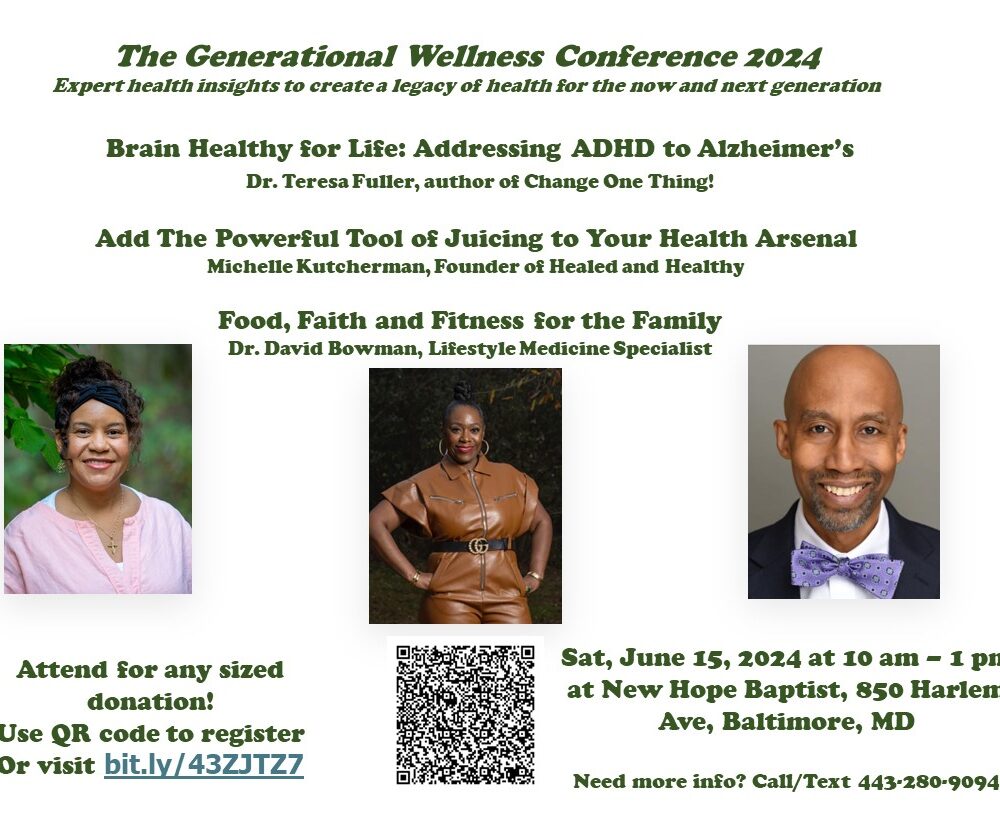
The Generational Health Conference 2024

March 18, 2024 by admin

Join us on June 15th to learn about brain healthy living, the power of juicing, fitness tips and more!

Register Here

Filed Under: Dr. T's Blog, front-page Tagged With: ADHD, Alzheimers, brain health, family health, health, juicing

Has life expectancy substantially improved in the past 100 years?

August 10, 2011 by admin

Watching an interesting show.  “Morgan Freeman’s Through the Wormhole.” It’s a fascinating show about indefinitely extending longevity.  The show started out by stating that human life expectancy has doubled from 40 years to approximately 80 years over the past 200 years due to medical breakthroughs.  But this often quoted statistic ignores an important detail.  Over one hundred years ago, in 1900, if you lived to 45, you had a good chance of living to 70.  A person today who lives to 45 can expect to live to age 76.  Therefore, using this perspective, we’ve only seen a six year gain in life expectancy over the past century.  In fact, we are now anticipating a shorter life expectancy in the coming generations, because of the epidemic of obesity and its associated diseases.  We can reverse this trend with the right eating and lifestyle choices.  www.ahealthytomorrow.org

Filed Under: Dr. T's Blog Tagged With: health, life expectancy, obesity

Copyright © 2026 · Wellness Pro on Genesis Framework · WordPress · Log in